Table of Contents
From Idea to Impact: Explore the Best Ai Tools for Content Creation
In today’s fast-moving digital environment in 2026, content is being produced and consumed faster than ever before. From social media posts and SEO blogs to videos, podcasts, and visual content, creators are expected to deliver more high-quality content in less time. This is where artificial intelligence has become a powerful part of the modern content creation process.
AI has evolved far beyond basic automation. Today, AI-powered platforms can help creators brainstorm ideas, write and edit content, generate images, create videos, produce voiceovers, optimize content for search engines, and repurpose existing material within minutes. Whether you’re a blogger, social media creator, digital marketer, or part of a professional content team, AI can simplify multiple stages of the creative workflow.
But speed isn’t the only advantage. The right AI tools can help improve content quality, maintain consistency, understand audience preferences, and generate ideas based on specific goals. Many modern platforms can also adapt to different writing styles, tones, formats, and content requirements, making them more flexible than ever.
In this guide, we’ll explore some of the best ai tools for content creation in 2026. Whether you want to save time, improve your workflow, create engaging content, or stay competitive in the rapidly changing digital landscape, these tools can provide practical solutions for modern creators.
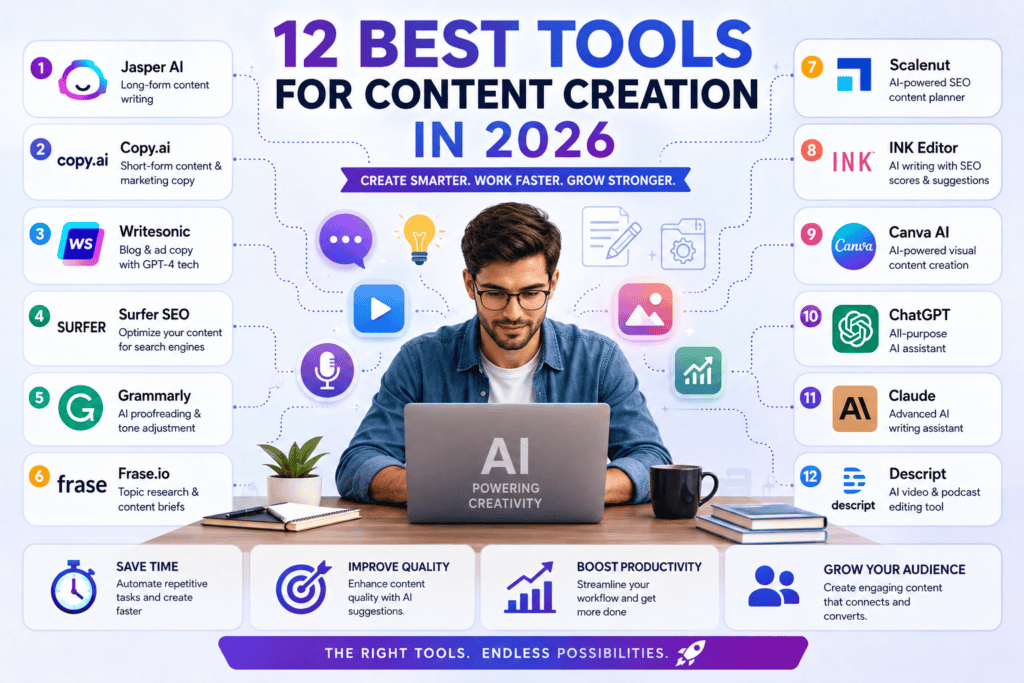
A Guide to Scaling Your Content Output: What Are the Best AI Tools for Content Creation?
The best AI tools for content creation are artificial intelligence-powered computer systems designed to help organize and improve the process of developing digital content. These tools understand input and produce outputs including text, photos, videos, and even music by using technologies such as machine learning, generative AI, and natural language processing.
The purpose is to enhance consistency and creativity in your material, minimize tedious work, and save time. AI image-generation tools can produce stunning pictures for social media, while AI writing software can help create blog posts or email marketing campaigns in a single click.
Examples of typical use cases include product descriptions, email marketing, video scripting, social media content planning, and blogging. Whether you are a business owner, content developer, or marketer, these tools can help you produce more content without sacrificing quality.
Explore the Best AI Tools for Content Creation
As we move through 2026, the demand creators, marketers, and businesses have for content continues to grow. Due to this increasing workload, AI tools for content creation have become valuable resources for producing quality content efficiently.
In this guide, we will explore the tools creators can use to save time, improve workflows, and create better content.
1. Jasper AI – Long-Form Content Writing
Features: Writing blogs, articles, and ebooks with the help of AI.
Pros: Ideal for bloggers who rely heavily on structured long-form content. Jasper offers several tone options.
Cons: Jasper can be expensive.
Who should use this: Bloggers, authors, and content marketers.
Jasper AI can serve as a blogging partner throughout the content creation process, from drafting ideas to producing refined content.
2. Copy.ai – Short-Form Content and Marketing Copy
Features: Creates social media posts, email copy, headlines, and other marketing content.
Pros: Easy and intuitive user interface.
Cons: Copy.ai is particularly useful for short-form content.
Who should use this: Social media marketing specialists and digital marketers.
3. Writesonic – Blog and Ad Copy
Features: AI-powered blog writing, ad copy, landing pages, and SEO content.
Pros: Offers strong value with a range of SEO functionalities.
Cons: Some content may require additional editing and polishing.
Who should use this: Startup teams, creators, and advertising professionals.
Writesonic is an accessible tool that can help generate blogs, advertisements, landing pages, and other marketing content.
4. Surfer SEO – Optimize Your Content for Search Engines
Features: SEO scoring, keyword research, content auditing, and optimization recommendations.
Pros: Provides detailed content optimization guidance.
Cons: Some features and concepts may be difficult for beginners to understand.
Best for: SEO professionals and strategic content planners.
5. Grammarly – AI Proofreading and Tone Adjustment
Features: Grammar checking, tone suggestions, spelling corrections, and clarity improvements.
Pros: Easy integration with documents and browsers.
Cons: Creative assistance is more limited compared with dedicated AI writing platforms.
Best for: Writers, editors, students, and professionals.
6. Frase.io – Topic Research and Content Briefs
Features: Topic research, content-gap analysis, and outline creation.
Pros: Reduces the time spent planning content.
Cons: The interface may take some time for new users to learn.
Ideal for: SEO teams and content strategists.
7. Scalenut – AI-Powered SEO Content Planner
Features: Content outlines, keyword clustering, SEO planning, and AI writing.
Pros: Provides comprehensive content planning features.
Cons: Limited visual content creation features.
Ideal for: Agencies, bloggers, and SEO professionals.
8. INK Editor – AI Writing and SEO Optimization
Features: AI writing assistance, SEO assessment, content optimization, and ranking suggestions.
Pros: Combines writing and SEO features in one platform.
Cons: May offer fewer content creation options compared with some competitors.
Ideal for: Entrepreneurs, writers, marketers, and content creators.
9. Canva AI – AI-Powered Visual Content Creation
Features: AI-assisted design, text-to-image generation, templates, and creative suggestions.
Pros: Flexible drag-and-drop interface.
Cons: Some AI-generated text and advanced creative features may have limitations.
Ideal for: Designers, social media creators, and visual content professionals.
10. ChatGPT – An All-Purpose AI Assistant
Features: Content ideas, drafts, brainstorming, Q&A, research assistance, and coding help.
Pros: Extremely flexible and customizable.
Cons: Requires clear and specific prompts to achieve the best results.
Ideal for: Writers, marketers, students, and multitasking creators.
11. Claude – An Advanced AI Writing Assistant
Features: Generates ideas, writes and edits long-form content, summarizes information, and helps with research and brainstorming.
Pros: Excellent for detailed writing and handling long, complex content.
Cons: Some advanced features require a paid plan.
Ideal for: Writers, bloggers, marketers, and creators working with long-form content.
12. Descript – AI-Powered Video and Podcast Editor
Features: Text-based video and podcast editing, filler-word removal, captions, audio enhancement, and content repurposing.
Pros: Easy-to-use editing workflow with powerful AI features.
Cons: The free plan has limitations on usage and exports.
Ideal for: Video creators, podcasters, YouTubers, and social media content creators.
The best AI content creation software can do more than automate repetitive tasks in 2026. It enables creators to work smarter, faster, and more efficiently while producing engaging content across different platforms.
Choosing the Best AI Tools for Content Creation for Your Needs
With the wide range of options available today, choosing the right best AI tools for content creation depends on your individual goals and workflow. Start by defining the type of content you want to create. Are you interested in writing long blog posts, making social media updates, creating video scripts, or producing SEO-based web content?
Your content goals will help narrow down the tools that best fit your requirements.
Consider Your Budget
Some AI tools provide free trials with restrictions, while others use monthly subscriptions or pay-per-use pricing. Consider whether the features and overall value justify the cost for your specific needs.
Focus on the Features You Need
Look for tools that support your key requirements. For example, if SEO is your priority, tools such as Surfer SEO or INK Editor may be useful.
Choose Tools Based on Your Content Type
For long-form writing, tools such as Jasper, Writesonic, and Claude can be useful. For visual content, Canva AI can simplify the design process, while Descript is better suited to video and podcast editing.
Consider Integrations and Collaboration
Some tools integrate with other applications and support team collaboration. These integrations can make your workflow more efficient and save valuable time.
Pro Tips for Using the Best AI Tools for Content Creation
Using the best AI tools for content creation can significantly improve your productivity, but getting the best results requires more than simply generating content.
Review and Fact-Check AI-Generated Content
Always review, fact-check, and edit AI-generated outputs before publishing them. Add your own experience, opinions, examples, and brand voice to make the content more authentic and engaging.
Combine Multiple AI Tools
Another effective strategy is to combine different AI tools based on their strengths. For example, you can use ChatGPT or Claude for brainstorming and writing, Canva AI for visuals, and Descript for editing videos or podcasts.
Keep Your AI Tools Updated
AI platforms are continuously introducing new features, improved models, and smarter workflows throughout 2026. Regularly checking updates can help you discover better ways to save time and improve content quality.
Let AI Support Your Creativity
AI should support your creativity rather than replace it. The strongest content combines AI efficiency with human expertise, originality, and editorial judgment.
Conclusion
AI has transformed content creation in 2026, making it faster, more efficient, and more accessible than ever. Whether you’re a blogger, marketer, social media creator, or business owner, AI tools can help you save time, improve content quality, and explore new creative ideas.
From brainstorming and writing to visual creation, video editing, and content optimization, there is now an AI solution for almost every stage of the creative process.
The key is to choose tools that match your specific goals and workflow. Start with a few options, experiment with their features, and combine them where needed. With the right strategy, the best AI tools for content creation can become valuable creative partners, helping you produce better content while keeping up with the rapidly evolving digital landscape.
What are AI content creation tools?
AI content creation tools are computer programs utilizing artificial intelligence to assist in creating written, visual, or audio content. They can automate activities such as writing blog content, creating visuals, or search engine optimization.
Are AI tools beginner-friendly?
Yes, most AI tools are easy to use and designed for creators of all skill levels. The majority of them have templates, tutorials, and easy-to-use interfaces to make it easy for beginners to start.
Can AI tools substitute human writers?
Not quite. AI may make content creation faster and provide useful recommendations, but human touch is still necessary for creativity, tone, and emotional engagement.
How much do AI content tools cost?
Prices are all over the map. Some tools have free versions with limited capabilities, while more premium tools charge monthly or per word. It depends on your requirements and budget.
What are the top AI content creation tools in 2026?
Among the top AI content creation tools of 2065 are Jasper AI, Copy.ai, Writesonic, Surfer SEO, Claude and ChatGPT, each with specific features for specific content types.