Table of Contents
Best AI Tools for Medical Students to Study Smarter
Artificial intelligence is transforming the way medical students study, research and prepare for their future careers in 2026. Students have a lot of materials to read, research papers, medical terminology, and complex clinical information to comprehend. It is difficult for them to manage their workload and study time properly. AI tools can help to make this process easier by summarizing long materials, explaining difficult concepts, organizing study notes and providing instant learning support.
One of the biggest pros is accessibility. There are many free features offered by AI platforms that help students cope with their studies without the need to pay for expensive educational software. Artificial intelligence can also supplement traditional medical education by generating revision materials, helping in medical research, practice clinical scenarios and preparing for exams.
In this guide, we’ll explore the best AI tools for medical students in 2026 that can support productivity, strengthen understanding, simplify research, and provide smarter ways to prepare for exams and future professional practice.
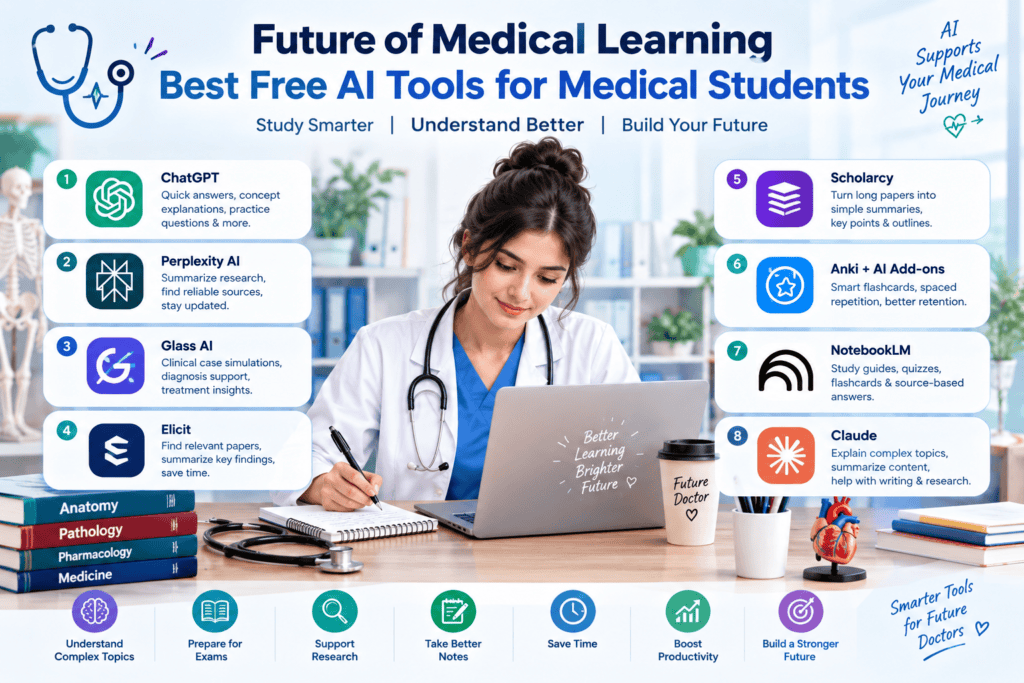
Why the Best Free AI Tools for Medical Students Are Necessary
One of the most difficult academic paths is studying medicine, which calls for extensive reading, comprehension of intricate theories, and practical experience. Students are now using technology to manage this workload. The best free AI study tools for medical students are more than just study aids; they are intelligent companions that make learning easier, increase output, and lessen stress. They are becoming essential for the following reasons:
Making Complex Medical Concepts Simpler
Anatomy, pathology, and pharmacology are medical specialties that can be very intimidating. By simplifying complex ideas into concise summaries, visual diagrams, and explanations, AI tools help people comprehend and remember them.
Saving Time by Using the Best Free AI Tools for Medical Students
AI-powered flashcards, automated notes, and instant topic breakdowns save hours of study time. Students can focus on learning rather than wasting time organizing materials.
Enhancing Research and Data Analysis
Although journal analysis can be time-consuming, medical research is essential. By summarizing articles and highlighting significant insights, the best free AI tools for medical students facilitate literature reviews for students.
Improving Exam Preparation and Clinical Skills
AI-generated practice tests, clinical case simulations, and real-time feedback can help medical students prepare for exams and enhance their diagnostic skills. In short, the best free AI tools for medical students provide smarter, faster, and more reliable ways to study and succeed in medicine.
The Best AI Tools for Medical Students Worldwide
Technology is transforming modern medical education, making it easier for students to study complex subjects, conduct research, and prepare for exams. The best AI tools for medical students can help simplify difficult medical concepts, summarize lengthy study materials, organize notes, and support more efficient learning. Many AI platforms also offer useful free features, making them accessible to students worldwide without requiring expensive software.
From AI-powered study assistants and research tools to writing, note-taking, and exam preparation platforms, students now have a wide range of options to support their academic journey. The following are some of the most useful AI-powered tools medical students can explore in 2026.
1. ChatGPT: One of the Best Free AI Tools for Medical Students for Quick Answers
- Provides concise, intelligible answers to challenging medical questions.
- Helps simplify complex topics like pathology, pharmacology, and physiology into digestible notes.
- Can be used to create practice questions, summaries, and explanations for revision.
- Ideal among the best free AI tools for medical students for responding to inquiries during late-night study sessions when instructors or peers are unavailable.
2. Perplexity AI: A Reliable Medical Research Assistant
- Summarizes journal articles and directly references credible medical sources.
- Keeps students up to date on the latest findings and research in medicine with the best free AI tools for medical students.
- Saves time by responding quickly instead of reading lengthy documents.
- Outstanding at writing assignments, conducting research, and evaluating case studies.
3. Glass AI: A Clinical Case Analytical Tool Driven by AI
- Designed especially for healthcare education and clinical case simulations.
- The best free AI tools for medical students aid students in understanding symptoms, diagnosis, and available treatments.
- Helps close the gaps in clinical training between theory and practice.
- Useful for preparing case discussions and refining diagnostic reasoning skills.
4. Elicit: An All-in-One AI Tool for Medical Students
- Finds pertinent papers in a matter of seconds, which expedites the research process.
- Saves hours of manual reading by summarizing key findings from several studies.
- Makes it easier for students to conduct literature searches or systematic reviews.
- Ideal for evidence-based assignments, journal clubs, and thesis writing.
5. Scholarcy: An Intelligent Instrument for Article Summarization
- Reduces lengthy, intricate research papers to easily readable summaries.
- Outlines the main conclusions, findings, and outcomes in an easy-to-read manner.
- With the best free AI tools for medical students, the time will be saved for those who must read several articles every day.
- Simplifies the process of reviewing and remembering important research points for tests.
6. Anki + AI Add-ons: Intelligent Memorization Flashcards
- Makes use of AI-powered flashcards for spaced repetition and active recall.
- The best free AI tools for medical students allow them to learn drug classifications, biochemical pathways, and anatomy terminology.
- For improved retention, AI add-ons recommend personalized revision plans.
- Aids students in effectively preparing for tests such as the MBBS finals, PLAB, or USMLE.
7. NotebookLM: An AI-Powered Medical Study Assistant
- Summarizes medical textbooks, research papers, lecture notes, and uploaded PDFs.
- Helps students understand complex medical topics using their own study materials.
- Generates study guides, key points, quizzes, and flashcards for exam preparation.
- Allows students to ask questions and receive answers based on their uploaded sources.
- Organizes large amounts of medical information into easier-to-review formats.
- Saves time by quickly extracting important information from lengthy documents.
- Supports more focused learning by keeping study questions and answers connected to reliable source material.
8. Claude: An Intelligent AI Assistant for Medical Students
- Explains complex medical concepts in simple and easy-to-understand language.
- Helps summarize lengthy research papers, textbooks, notes, and academic documents.
- Supports students with brainstorming, assignment planning, and academic writing.
- Can analyze detailed medical information and compare different concepts or topics.
- Helps create study notes, revision questions, and structured learning materials.
- Saves time by processing and organizing large amounts of information quickly.
- Useful for research, case-study analysis, exam preparation, and improving overall study productivity.
- Provides detailed responses that can help students explore difficult medical topics from different perspectives.
How Medical Students Can Select the Best AI Tool
Finding the best study aid is crucial, and medical students need to exercise discernment because there are so many platforms available. Selecting the best free AI tools for medical students is crucial, but they can save time and enhance outcomes. Here are three things to think about:
Verify the Information’s Accuracy and Dependability
Particularly in the medical field, not all tools offer accurate content. Always double-check information with reliable sources, such as standard textbooks or PubMed. Clear explanations and references to legitimate research are hallmarks of trustworthy tools.
Select the Best Free AI Tools for Medical Students With Affordable Plans or Free Access
Because medical school is costly, choose AI platforms that provide free access or reasonably priced student plans. This guarantees that necessary study assistance won’t result in additional financial strain. The best free AI tools for medical students strike a balance between usability and quality.
Select Study Aids That Work for You
Every student has a unique learning style. While some people benefit from summaries or research assistance, others favor flashcards. To increase productivity, choose AI tools that complement your preferred method of learning. Students can choose the best AI tools for their medical journey by bearing these things in mind.
Challenges and Limitations of the Best Free AI Tools for Medical Students
The best AI tools for medical students can be helpful in making learning easy, but students should know the limitations of these tools before relying on them.
Accuracy and Outdated Information
AI may provide incorrect, outdated, or partial medical information. Students should always verify AI responses with credible textbooks, medical journals, and official sources.
Over-Reliance on AI
Over-reliance on AI may also hinder independent learning, critical thinking, and clinical reasoning skills that are essential to medical education and future practice.
Data Privacy
Data privacy is another concern, especially when students input personal, academic, or sensitive clinical data into AI platforms without verifying their privacy policies.
Free Plan Limitations
Some best AI tools for medical students have limited features on free plans, and students may need to upgrade to paid subscriptions to unlock advanced features or higher usage limits.
Internet Dependency
Internet dependency can also be a drawback because many AI platforms require a stable connection, making them less convenient for offline studying or areas with limited connectivity.
Conclusion
In 2026, technology is changing medical education, changing how students learn, how they do research and how they prepare for exams. AI tools can assist future doctors in tasks from breaking down complicated medical concepts to summarizing research, creating study materials and enhancing exam prep.
However, students should use these tools responsibly and be mindful of concerns regarding accuracy, data privacy, and over-reliance on AI. When used alongside traditional learning methods, the best AI tools for medical students can help enhance study efficiency, solidify knowledge, and provide helpful academic help.
By using AI as a learning aid, rather than a replacement for professional guidance and critical thinking, students can build stronger skills and better prepare for future careers in healthcare.
In 2026, which are the best free AI tools for medical students?
ChatGPT, Perplexity AI, Glass AI, Elicit, Scholarcy, and Anki with AI add-ons are the top free AI resources for medical students.
How can medical students prepare for exams using AI tools?
AI tools facilitate exam preparation by offering practice questions, flashcards, and concise topic summaries.
Are free AI tools trustworthy for supporting medical research and studies?
Indeed, a lot of the best free AI tools for medical students are trustworthy, but you should always double-check them with reputable medical sources.
Which artificial intelligence tool is most effective at summarizing articles from medical journals?
Two great free AI tools that condense lengthy research papers into brief notes are Scholarcy and Elicit.
Can medical students use AI flashcards for anatomy and pharmacology revision?
Yes, Anki with AI-powered add-ons is ideal for memorizing anatomy terms, pathways, and drug lists.